Showing posts with label French Cinema. Show all posts

Sunday, April 3, 2011

Annoying Gym Singer, Too Much TV, Harlow & Clarke, A Lighter Shade of Bergman And An "Interesting" Film

Today in the gym there was an awful sounding racket emanating from a woman's mouth. It suggested a wolverine drowning. Several of us looked over in her direction only to discover that this woman was "singing" in accompaniment to her IPod.  Her shoulders were shimmying, apparently in response to the music. These movements looked to be less a rhythmic reaction to pleasant sounds and more an upper body seizure. Our performer was a greying woman on the downhill side of middle age. No one wants such distractions when trying to lift weights. Least of all disagreeable ones. There's one bloke I see at the gym all too often who hums incessantly. We don't need that. Then there are those who go beyond the expected grunts and groans huffs and puffs that normally accompany vigorous exercise. There's one chap who when running on the treadmill sounds like a winded water buffalo. It's heard to imagine a human can make such a sound. And don't get me started on all the whistling in the locker room....

I'd been pushing myself physically recently and keeping generally quite busy besides. So I designated yesterday as a day to stay off my feet and do nothing more taxing than operating the remote control. I ended up watching three movies, a soccer match, part of a baseball game, part of a hockey game, an episode of HBO's The Ricky Gervais Show (absolutely love him and the show) and glimpses of the NCAA basketball tournament and a few other shows including the first half hour of Saturday Night Live. All this in a span of 14 1/2 hours. Yikes! Talk about binge watching. Besides the visit to the gym I'm doing some serious reading and writing today to balance the scales a bit, although it'll take several days, if not weeks, to offset so much time in front of the idiot box.....

The first two films I watched were part of TCM's pre code Forbidden Hollywood set. They were Red-Headed Woman (1932) starring Jean Harlow and Waterloo Bridge (1931) featuring Mae Clarke. I'd seen both films before but only once and in each case a good five years or so ago. Like gazillions of other people I love Jean Harlow. As she did on occasion, in Red Headed Woman she plays a right proper stinker. She was as a subtle as jackhammer in her use of men for riches and attendant comfort. Harlow was even better playing sweetie pies. Her life was cut way, way, way too short at age 26. Yet she still appeared in Red Dust (1932), Hell's Angels (1930), Platinum Blonde (1931)Bombshell (1933), Dinner at Eight (1933), The Public Enemy (1931), China Seas (1935), Libeled Lady (1936) and Wife vs. Secretary (1936), plus whatever the hell slipped my mind. That's all in an eight year span. It's mind boggling to think what more she'd have done in another 30 or so years.....

Much as I love Harlow, I preferred the second feature of my matinee yesterday. Mae Clarke, best known for getting a grapefruit facial from James Cagney in the aforementioned Public Enemy, was -- and I hate myself for overusing this word -- underrated. If you're unfamiliar with Ms. Clarke, just watch Waterloo Bridge (and for God's sakes don't waste your time with the saccharin re-make). She plays an out-of-work chorus girl in WWI London whose had to turn to prostitution to make ends meet. A naive young solider from a wealthy family falls for her and she tries to do what she envisions is the right thing. The -- oh my God here it comes again -- underrated James Whale directed. Douglass Montgomery, who didn't have much of career otherwise, was wonderful as the love struck 19 year old. Waterloo Bridge is quintessential pre code viewing and indeed a must see for any film lover. Yes, I think it's underrated.....

Last night the missus and I watched Ingmar Bergman's Smiles of a Summer Night (1955). It is much lighter fare than the great Swedish director typically made. It is a ribald comedy chock full of mistresses, adultery and illicit liaisons. Quite the thing for the mid 1950's. Virtually every great director can successfully make a film in another genre. I'd wager that Martin Scorsese could make a jim dandy Western if he'd a mind to. Smiles was the inspiration for one of Woody Allen's lesser efforts, A Midsummer Night's Sex Comedy (1982). You could argue that Allen successfully adopted many of the aspects from Smiles in other of his films. But I tend to believe that Smiles is the type of movie Allen would and has naturally made and in many cases better. In any event, Smiles is a delight and while a joyous romp still introduces themes of life and love that Bergman dealt with quite seriously in other films....

Ever hear anyone refer to a film as "interesting"? What they're generally saying is that the picture wasn't all that good but boasts other merits, such as a star playing against type, or a unique visual style or an eclectic cast or the first of its kind. "Interesting" movies are usually badly flawed but not a waste of time as watching them serves another purpose. You just had to see so-and-so in a musical, or what's-his-face's first film or the unique pairing of him and her. Sometimes you don't know in advance that you're going to watch an "interesting" film. You go in looking forward to seeing something special and finish being satisfied that, well at least it was "interesting".  So it was the other day when I watched a film called The Law (1959) directed by Jules Dassin. The cast featured Gina Lollobrigida, Marcello Mastroianni, Melina Mercouri and Yves Montand. Not too shabby. The Law was set in Italy with a primarily Italian cast but directed by a Frenchmen and spoken in French. Of course. It was a howlingly adequate film, though at two hours pushes the boundary of how long a film can be mediocre before it slips into bad. Ms. Lollobrigida was at her loveliest, which is much like saying that the sun was at it's hottest. Fifty years ago she could be gorgeous doing push ups with a baggy grey sweatsuit on. Mastorianni was charming as ever and there were all manner of interesting characters and incidents but thrown all together it just didn't work. It was like putting a lot of really tasty ingredients together to make a bad stew. Except that it was "interesting"....

Now I ask a personal favor. If anyone is acquainted with a woman who makes noises akin to a walrus in heat whilst listening to the music on her IPod. Please do us all a favor and tell her to put a sock in it. At least while she's out in public. Cheers.

Sunday, October 10, 2010

In Honor of Today Being 10/10/10 I Offer 10 Lists of 10

The last time the date was 10/10/10 I did not have this film blog so this is the first such post I've ever done.  Yes when the calender last featured a trio of tens times were different indeed. The Kaiser ruled Germany, Babe Ruth had not yet debuted with the Red Sox and movies were still more than a decade from fully incorporating sound. The internet was in its infancy....But I digress.

Today I offer what I couldn't 100 years ago in recognition of the date. Ten film lists of ten films apiece. Please note that not all are in order and none are annotated.

Ten Great Films From Italy
1. Amarcord (1973)
2. 8/12 (1963)
3. Open City (1945)
4. Nights of Cabiria (1957)
5. Bicycle Thieves (1948)
6. Paisan (1946)
7. Umberto D. (1952)
8. Two Women (1960)
9. La Dolce Vita (1960)
10. La notti bianche (1957)

Ten Terrific Westerns
1. The Searchers (1956)
2. Stagecoach (1939)
3. Red River (1948)
4. The Wild Bunch (1969)
5. Westward the Women (1951)
6. Ride the High Country (1962)
7. The Naked Spur (1953)
8. The Big Trail (1930)
9. The Man Who Shot Liberty Valance (1960)
10. The Westerner (1940)

Ten Movies That Crack Me Up
1. Animal House (1978)
2. Duck Soup (1933)
3. The Palm Beach Story (1942)
4. Stripes (1981)
5. Some Like it Hot (1959)
6. Trading Places (1983)
7. Safety Last (1923)
8. Monty Python and the Holy Grail (1975)
9. Bananas (1971)
10. The Gold Rush (1925)


My Ten Favorite Hitchcock films
1. Vertigo (1958)
2. Foreign Correspondent (1940)
3. Shadow of a Doubt (1942)
4. Psycho (1960)
5. Strangers on a Train (1951)
6. The 39 Steps (1935)
7. Notorious (1946)
8. Mr. and Mrs. Smith (1941)
9. The Lady Vanishes (1938)
10. I Confess (1953)

Ten Films I Like a Lot That Have A Person's Name For the Title
1. Annie Hall (1977)
2. Rebecca (1940)
3. Barry Lyndon (1975)
4. Arthur (1981)
5. Ninochka (1939)
6. Ed Wood (1994)
7. Ali (2001)
8. Vera Drake (2004)
9. Milk (2008)
10. Mildred Pierce (1945)

Ten Best American Films From the First Half of the 1970s
1. The Godfather (1972)
2. Cabaret (1972)
3. A Clockwork Orange (1971)
4. The Exorcist (1973)
5. The Godfather Part II (1974)
6. The Sting (1973)
7. Mean Streets (1973)
8. The Last Picture Show (1971)
9. The Conversation (1974)
10. Little Big Man (1970)


Ten Fantastic French Films From the 1960s
1. Shoot the Piano Player (1960)
2. Le Samouri (1967)
3. Band of Outsiders (1964)
4. Jules et Jim (1962)
5. Breathless (1960)
6. Vivre Sa Vie (1962)
7. Army of Shadows (1969)
8. The Two of Us (1967)
9. The Sorrow and the Pity (1969)
10. The Fire Within (1963)

Ten Great Films Based on Actual Events
1. Goodfellas (1990)
2. Raging Bull (1980)
3. Schindler's List (1993)
4. The Great Escape (1963)
5. JFK (1991)
6. Zodiac (2007)
7. The Bridge on the River Kwai (1957)
8. Bonnie & Clyde (1967)
9. Lawrence of Arabia (1962)
10. The Social Network (2010)


Ten Movies With Trial Scenes
1. The Verdict (1982)
2. Inherit the Wind (1960)
3. Paths of Glory (1957)
4. Wild Boys of the Road (1933)
5. To Kill a Mockingbird (1962)
6. Midnight Mary (1933)
7. Philadelphia (1993)
8. Witness for the Prosecution (1957)
9. Two Seconds (1932)
10. Amistad (1997)

Ten Films in Which People Watch a Film
1. Cinema Paradiso (1988)
2. Vivre Sa Vie (1962)
3. Sunset Blvd. (1950)
4. Sullivan's Travels (1941)
5. Shoe-Shine (1946)
6. The Last Picture Show (1971)
7. Gods & Monsters (1998)
8. The Purple Rose of Cairo (1985)
9. The Aviator (2004)
10. Hannah and Her Sisters (1986)

Thursday, June 3, 2010

Films Loved by Film Lovers -- Foreign Language Edition

In my previous post I took on the daunting task of naming films that I believe are particularly loved by film lovers. I simplified the task by naming one per decade and restricting myself to English language films.  Today I offer the sequel to my original post with foreign language offerings.

Before preceding I quote from from that first entry: In no instance am I suggesting that any one of these films is universally loved by every single movie aficionado, such a thing is impossible. And as will quickly become obvious, I have not picked any films lacking broad appeal. I merely mean to say that to the majority of those people to whom movies are more passion that diversion, these films are highly esteemed.

20s Nosferatu (1922). Eighty-eight years after it premiered Nosferatu remains a one of the best horror films ever made. As I said in a post from last FallNosferatu is like a nightmare. Not a gross disgusting one that you want to run away from. No this is a bewitching, beguiling nightmare that despite the better angels of your nature you want to behold. More than that, you want to follow -- where will it take me? Surely this is ultimately harmless, it's only a dream (a movie). All those haunting images and that's not even including Count Orlock (Max Schreck).

30's Grand Illusion (1937). On the surface this is a World War I POW escape film but it is clearly so much more. French director Jean Renoir's masterpiece is also very much about classism, particularly the type that was dying in Europe. It is at once a subtle and clear film, acclaimed by many as a perfect movie. Jean Gabin and Erich von Stroheim lead a terrific cast.

40's Open City (1945). This film from Roberto Rossellini about the resistance movement in Rome during World War II was made just months after the events depicted. Add to this the use of non actors and the actual locations and you've got the greatest example of neorealism ever made. It is heartbreaking, compelling cinema that inspired a genre.

50's The Seventh Seal (1957). Like Grand Illusion, there are those who consider this a perfect film. It is considered by many to be Swedish director Ingmar Bergman's best, which is saying a lot in and of itself. In being so much about death it is really about living and the joys thereto. I expounded on the film recently in this post.

60's Closely Watched Trains (1966). War torn Czechoslovakia is not the ideal setting to "come of age" sexually but one often has to make do. From Czech director Jiri Menzel comes this story of a young train dispatcher who ends up combining sexual awakening with resisting the Nazis. It all comes together in one of the sweetest and saddest films ever made. It's one that could easily have lapsed into sentimentality but managed to avoid cliches and hit all its marks.

70's Aguirre the Wrath of God (1972). In the nearly four decades since completing Aguirre, director Wernor Herzog has continued churning out all manner of outstanding films including documentaries. However this still stands as the piece de resistance of his career. It is a trip. Both in the slang and traditional senses. The story of an ill fated conquistador's search for the mythic El Dorado in the Amazon jungle is a magically crafted elegy.

80's Ran (1985). Akira Kurosawa enjoyed wide appeal among critics and mass audiences alike. You'd be hard pressed to find a film lover who was not a fan of the Japanese director. Any number of his films could have made this list. Clocking in at nearly nearly three hours, Ran is grand, epic film making at its best. It is also one of the better cinematic versions of a Shakespearean play, based as it is on King Lear. Made when Kurosawa was 75 years old and after 45 years of making films, Ran proves the master's skills did not fade with age.

90's All About My Mother (1999). Many of Pedro Almodovar's most ardent fans have expressed varying degrees of disappointment with his latest directorial efforts. It is in good part because of films like All About My Mother which served to set the bar so very high. This is among the Spanish director's most revered films. At his best Almodovar is an excellent director of women and women's stories and this film, starring the wonderful Cecilia Roth, is an excellent example.

00's Barbarian Invasions (2003). The last days of a dying college professor are the subject of this intellectually stimulating French-Canadian film from director Denys Arcand. What could be morbid subject matter is instead engrossing as the soon-to-be-deceased is surrounded by close friends and family for some hearty laughs and provocative discussions. It's one of those films that introduces topics crucial to the very core of our existence.

Others: Le Samurai (1967), La Strada (1954), Port of Shadows (1938), Beauty and the Beast (1946), Y Tu Mama Tambien (2001)Celebration (1998), Metropolis (1927), Murmur of the Heart (1971), Mephisto (1981), Smiles of a Summer Night (1955).

Monday, May 31, 2010

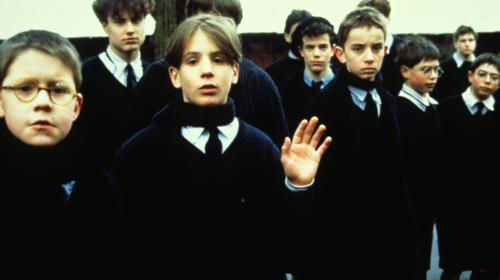
Parting is Not Always So Sweet a Sorrow -- Malle's Au revoir les enfants

There are some wounds, both physical and psychological, that neither time nor therapy will ever fully heal. For Louis Malle such a scar was inflicted him when at age 12 he watched a friend being led away by the Nazis. That friend was a Jew and he would die at Auschwitz.

Malle undoubtedly found some catharsis in making a movie that climaxed with that incident, Au revoir les enfants (1987).

Some films are technically perfect but have no soul. There is not a wasted shot, the story flows, the performances are all spot on but while watching the movie is an enjoyable experience, it is also ultimately forgettable one. Not so with ARLE which embodies both the superior craftsmanship of Malle the director while being an expression from the heart of Malle the man.

Julien is a 12 year old mama's boy sent off by his glamorous mom to a Catholic boarding school to avoid the perils of war time Paris. It is early 1944 and liberation is still a dream for the French. The Nazis and their French collaborators have a firm grip on many aspects of life. The students at the school include three Jews living under assumed names, their true identities unknown by their classmates.

Gradually Julien and one of the Jewish lads, Jean, become fast friends. And gradually Julien discovers Jean's secret. Julien is no anti semite, indeed he's not even altogether sure what a Jew is.

The film is as evocative a telling of boys' pre teens years as you'll ever see. ARLE never veers into sentimentality nor stoops for easy laughs in its depiction of boys at school and play. Even with their country occupied by enemy troops and with occasional bombs being dropped by their supposed allies, boys will be boys. Math class goes on. English essays must be written. Piano lessons are taken.


Young men are by nature borderline cruel as they test and tease one another. They are forever pushing boundaries with adults and are not hesitant to break rules if its suits them. But at the same time boys are starting to find their place in the world, separating from parents whether mom and dad are near or far or in concentration camps. Talents are being discovered or perhaps already being refined. Strong friendships that can last a lifetime or maybe just a week are formed.

Having armed Nazis about is paradoxically of no consequence and the greatest bogeyman imaginable. Life goes on amid all manner of calamity. Boys are resilient, though not unbreakable.

At the 12 year-old Malle's school the three Jews along with the school's headmaster were betrayed and the Gestapo came to take them on one fittingly cold January day.
It is the headmaster who utters the farewell that gave the film it's title. "Au revoir les enfants" (good bye children). Julien and the rest of school can only watch.

It was over 40 years after the real events occurred that the movie premiered. The wounds of watching a friend, two other classmates and the headmaster being taken away had not been healed for Louis Malle. There was, he said after, a sense of relief to having told the story, but one can't imagine it served as a cure-all for the pain inflicted that day.

Remarkably, Au revoir les enfants is not a depressing film, nor particularly sad. Oh sure a tear or two may form as the closing credits roll, but that's not what one if left with. The story is too rich, too well told to be trivialized as merely "a sad story." The characters, in lead, supporting and small roles, are expertly realized. Malle's direction is perfect and thus all the events within the story too memorable to be left with just one closing moment, no matter how powerful. And indeed it is one of the most touching and beautifully told endings in cinema. Yet is is just one part of a masterpiece.

What great fortune for Malle to be able to share the story. The telling of it gave him some solace while giving audiences a film not soon forgotten.

Wednesday, May 19, 2010

The Eternal Overcast of the Troubled Mind

Existential angst. A curse of the self aware. Introspection colored by philosophical musings. It's the occasional inability to merely take the next step in one's life without first contemplating its ramifications or those of the previous steps. Throw into the mix something like an addiction, or a deviancy or a mental quirk and you've got the recipe for a tortured soul. Or at least one that needs a lot of attention.

You've also got the recipe for a French film of the New Wave era -- Le feu follet (1963) (the English title is The Fire Within). It's directed by Louis Malle who adapted the script from a 1930's French novel that was undoubtedly inspired by the work of F Scott Fitzgerald. That for Malle this is more homage than rip off is evidenced by references to Fitzgerald during the film.

Some films seem trivialized by presenting a synopsis. It's like being asked of a complicated person: "what's he like?" You can summarize but it hardly does justice. But one must, so in this instance I'll cheat by copy and pasting IMDb's plot summary:

Life has become unbearably painful for Alain who is in his early 30s. He once used alcohol to dull the pain. His estranged wife in New York has paid for a cure at a clinic in Versailles and sends an emissary, one of the many woman he has known, to see how Alain is. She sees only the surface as does his doctor, who says it's time for Alain to leave the clinic. He goes to Paris the next morning and has lunch with old friends, a rendezvous in a cafe and is invited to a dinner party. Will Alain make a connection that will change his mind about ending it all?


Le feu follet is like a lot of great films in that is an invitation. In this case Malle is inviting viewers to follow the main character, Alain Leroy (Maurice Ronet) through various parts of Paris. But it is also a journey through one man's mind and we all know the curious directions such expeditions can take. The mind, the old ad campaign said, is a terrible thing to waste. But it can be a wonderful topic for a film. 


The pace of Le feu follet seems languorous. Malle might have added a fist fight or a car spun out of control or a sex scene. Through much of the movie I was hoping for such a diversion. Not bored, but uncomfortable by the meditative pace. Yet by the last frame I was exhilarated. It had all come together into a wonderful whole. A rich melange of episodes, some curious, others intoxicating. Isn't the thinking process the same? Lots of randomness, lots of going nowhere until viola


Here's an overused and overrated word: underrated. But sometimes it must be used, as in any discussion of Malle among great directors. If you need proof look no further then what a compelling film he made out the story of a recovering alcoholic wandering Paris. For one it is beautifully shot, serving as it does as another example of the powerful advantage black and white has over color cinema photography. Pacing in such a film is critical and Malle got it just right. The casting is spot on. Finding the right actor to play Alain was a chore for Malle given the somewhat autobiographical nature of the story.


Donet looks by turns like he must be the French first cousin of Tony Curtis or the Gaelic uncle of Jude Law. He's as good an actor -- if not better -- than both. In Le feu follet he carries the weight of a million woes and personal demons with nary a gesticulation nor frown. It's an incredible responsibility to have the camera trained on you for almost the entire running length of a film and Donet is equal to the task. He expresses more with his eyes or a turn of the head than many actors do with a long soliloquy.


Our Alain visits old haunts and friends. This includes a stop at an upscale opium den where Jeanne Moreau has a cameo. There is also an outdoor cafe where Alain's old army buddies rendevous and visits to flats both bohemian and upper, upper crust. It's a whirlwind 24 hours for a normal bloke but again not the usual stuff of movies. But the French New Wave was not just about different ways of telling stories but of telling a different sort of tale. Why not the curious meanderings of a troubled man?


Don't show Le feu follet to your 14 year old boy, especially if he's been fed on a steady diet of Spiderman and Iron Man (this is Thinking Man!). But for a mature person such as yourself....


This is an explorations of a character. Sad, troubled, sympathetic and altogether mysterious. It is not afraid to leave much to our imagination. I've written often, including in my last post, about admiring films that do not fill in all the blanks. I really don't mind if a film leaves me with room to think. I thank the director for dignifying me in such a way.


Le feu will also leave you yearning for Paris. A city to be fallen in love with again and again. Yes, the photography here would flatter Hoboken, but anyone having seen Paris will know that Le fou is a mere hint of its considerable charms.


This may well be a movie to fall in love with repeatedly. For me it was love at first sight.


Thursday, May 13, 2010

Don't You Just Hate it When You Commit the Perfect Crime Only to then Get Stuck in an Elevator?

The film opens with Jeanne Moreau's gorgeous 30 year old face filling the screen. She is saying, "I love you," repeatedly. Whatever happens for the rest of the movie, Ms. Moreau had me at "I...."

Elevator to the Gallows (1958) is French New Wave Film Noir. The noir aspect of it means that the crime at the heart of the story will not go unpunished. We live with this when we watch 40's and 50's noir. We will be sucked into sympathizing with characters that cannot, by the rules of cinema at the time, succeed.

If we allow ourselves to, we can wonder at how they will be undone. Better still we can enjoy the story for what it is. Like mystery and detective stories, characters must be well drawn and strong and the plot imaginative. Director Louis Malle's Elevator to the Gallows does not disappoint on either score.

Moreau's character, Florence, is married to a wealthy arms trader. He is an older man and we shouldn't be surprised that she has fallen for his younger, more handsome right hand man Julien (Maurice Ronet), a decorated army veteran. We shouldn't be surprised that anyone would fall for Florence or for that matter anyone else who looks like Ms. Moreau. Julien is so smitten that he'll kill the boss for her.

The first part of the crime comes off without a hitch. The cuckold is dead and for all the world it looks like a suicide and its impossible to see how Julien can be implicated. Ahh but there's always a matter of human error that will pop up along the way. When Julien realizes he has forgotten a rather conspicuous piece of evidence that would surely implicate him, he tries to return to the scene of the crime. But the elevator he rides gets stuck between floors and a whole unexpected chain of events have been set off.

This will include an amazingly stupid young couple who steal Julien's car and ride off into the night where they commit their own crimes. Meanwhile Julien has missed his rendezvous with Florence. She doesn't know what to think and proceeds to try to think it anyway. While walking the streets of Paris, sometimes in the rain, stopping at a bar or two in the process. This makes for some famous shots of Ms. Moreau that helped propel her to stardom. There was the raw beauty of her face, sans make up, that expressed so much of the inner turmoil that would surely be bubbling within this character. Malle's career was off and running from that point on as well.

Oddly, the two stars don't actually get the lion's share of screen time. The two misfit young crooks probably get an equal amount, but Moreau and Ronet are the ones we will remember. The teenaged thieves get into one deuce of pickle and subsequently manage to botch a double suicide. But while they're galavanting around it is the stoicism of the two older lovers that is the glue of picture. While Florence walks and wonders, Julien is left quite stuck in a confined space and alternately determined to extricate himself and resigned to his sad fate. Ronet, like Moreau, had to make do with very little dialogue and he was playing a man who was by nature self contained, methodical, unemotional. Not the easiest of parts and he handled it with aplomb.

The story twists and turns in surprising ways, that while seemingly not plausible are more than possible. We buy everything that happens within ETTG because we like its style so much.   The lovely soundtrack from Miles Davis, who recorded it in one night while chilling with Malle and Moreau and sipping champagne, is as indispensable to the story's allure as Moreau's face.

A key question about any film noir is whether, after having had its secrets revealed, you would want to watch it again. With regard to ETTG I am not alone in answering with an emphatic, yes. There is so much to enjoy that goes beyond plot points. Like any film that one considers "great" it is a joy to look at. Savor is the proper word for it. Any time a director decides to bookend his movie with the face of Jeanne Moreau, you know he's one smart cookie.

Sunday, April 11, 2010

I Stop in For a Quickie, Comments on Films I've Seen Recently

Before I get totally immersed in studying for my Second Language Acquisition class final (next Saturday, check your local listings for exact time and channel) I'm going to make a few quick comments about some of the films I've watched recently.  I offer these in no particular order and without further ado.

Female (1933). Ruth Chatteron is the wealthy CEO of a car company who uses men, sometimes as sexual playthings. At the risk of being obvious this is a pre code film and is in fact a classic example of the genre. Such a film would not only have been impossible to make in the first 30 years the code was enforced, its hard to imagine it today. Its so wonderful to see a woman in  charge, even if she finally does meet her match in George Brent.

Baby Face (1933). Another pre code film, this is to me the epitome of those daring movies made before the Hays office started its heinous censoring. Moreover its one of the better films of all time. Barbara Stanwyck couldn't be better as a woman who ruthlessly sleeps her way to the top, casting men aside like used banana skins. Like Chatterton in Female, she too gets more than she bargained for upon meeting George Brent. What was it with that guy?

Lacombe, Lucien(1974). It's a good enough film but one would certainly expect more from director Louis Malle. He set himself a heck of a task making the protagonist such an unlikeable fellow. While an interesting and never boring, LL does not show the craftsmanship of most other Malle films. This was my second viewing and I like it less, maybe because I first saw at the Pacific Film Archives on the big screen. It's the story of a somewhat dim witted young Frenchmen who stumbles upon and joins forces with the collaborationist French police force during Nazi occupation. Full of good performances.

King & Country (1964). Speaking of the PFA, I saw King and Country there last Thursday. I now have another film to add to my list of outstanding World War I movies. It's got elements of Paths of Glory (1958) though the man on trial here is actually guilty of the charges. Whether he deserves the death by firing squad is another matter. Tom Courteny is excellent as the naive  war weary young British soldier charged with desertion and Dirk Bogarde gives a superb performance as the officer who defends him (any Bogarde fans out there?). One of a legion of films that examines the lunacy of war. Done in 18 days on the cheap, it feels like a stage play but with all that rain and mud looks and is a really good film.

Shutter Island (2010) One of those rare films that I absolutely have to see again to decide upon. I wrote about it the other day so won't go on too long here other than to re-iterate that it has had a lingering effect on my thinking and even though I'm not sure how much I like it. Must see it again on the big screen.

Flame and Citron (2008). In terms of movies, World War II is the gift that just keeps on giving. Released last Summer in the States and now available on DVD was this film about two heroes of the Danish resistance. No, I knew nothing about the Danish resistance and in fact as much as I've studied the war I'd never given it much thought. Flame and Citron were the code names of two Danes whose primary jobs were as hit men. Their targets were generally Danes who'd gone bad, that is collaborated with the Nazis. It's a true story and a powerful one well told. Two relatively ordinary sorts become heroes due to the extremely unusual circumstances of the time and place. Appropriately bloody, sad, nerve wrecking and fascinating.

Sherlock Holmes and the Secret Weapon (1943). You're a fine actor Robert Downey Jr. but when it comes to playing Sherlock Holmes, give me Basil Rathbone anytime. As for Dr. Watson, I'll take the lovable Nigel Bruce over Jude Law or anyone else any time. That said this particular edition of the Rathbone/Bruce Holmes films is merely adequate. Likes others made during WWII it tries too hard to be anti Nazi and takes us away from what Holmes does best, match wits. Still a diverting and delightful film with a good bit of sleuthing.

Taxi Driver (1976). Wow. It's one of those cinematic experiences that makes you wonder what you should single out and praise. How about the performance of its star, Robert De Niro? You could also go with the screenplay by Paul Schrader. Maybe Martin Scorsese's direction? The supporting cast? A particular scene? The mood of the film? It's influence? Great films are like that. You find different things to admire with each viewing. This time I was struck by lead character Travis Bickle and his utter and complete separation from society. Bickle made attempts to engage with his fellow humans but really didn't have it in him. The one person he got along with was a teenage prostitute and she ended up having to watch him shoot holes through three people. It's a great story of an alienated man.

Germany Year Zero (1948). I've already promised to devote a whole post to director Roberto Rossellini's extraordinary war trilogy, of which this is the third part. I'd never see this one before and suffice it to say was suitably impressed. To say it belongs right up there with its predecessors, Open City and Paisan, is high praise indeed and praise I give without hesitation. See all three and meanwhile I'll try to find time in the coming weeks to go on and on and on about them. This latter is, as the title implies, set in Germany. The war has ended and we see that Germans are paying a heavy price for their defeat. We follow in particular one young lad trying against all odds to make the best of a sad situation.

Captain Blood (1935). I didn't so much watch it as have it on while I tended to other matters. It's a familiar enough film with Errol Flynn swashbuckling and Olivia de Havilland looking gorgeous, which of course came naturally for her. You also get Guy Kibbee, the great Mr. Rathbone, Harry Stephenson and Donald Meek. Michael Curtiz directed and he knew how to make a rollicking good adventure story. You can have your Pirates of the Caribbean, give me the pirate adventures of Hollywood's Golden Age.

Europa Europa (1990). This is one of those films that isn't terribly well told but you don't mind because its such an amazing story. A Jewish-German teenager living in Poland at the outbreak of World War II escapes the Nazis and is taken in by the Soviets.  When Germany and Soviets go to war he's on the run again until being captured by the Nazis. He pretends to be...well I could go on about this incredible tale. The kid ends up in of all places the Hitler Youth where he squires a young Jew-hating Aryan bird played by Julie Delpy. Wait a second, didn't I say earlier that he himself was a Jew? Yup. What makes it all the more remarkable is that this is a true story. Not a cinematic work of art but when the story is this compelling, who cares? Very well worth seeing.

Tuesday, March 2, 2010

The *Cough* Films *Cough* That Got Me *Cough* Through My *Cough* Bronchitis *Cough*

Last Friday I finally returned to blogging after an unplanned and unwanted hiatus that had Riku Writes fans all over the globe saying: "his blog isn't so bad when he's not updating it." I wrote about my horrific illness (actually it was just a cold that morphed into bronchitis) and also about the more serious health woes my big brother was surviving. I also mentioned that there were many films that helped get through and that I would write a word to two about them the next day. I didn't. Nor the day after that nor the day after that. But I am today as I'm finally catching up with my life (does that even make sense -- "catching up with my life"?). Here they are:

The Maltese Falcon (1941). Mary Astor's Brigid O'Shaughnessy is one of the most complex and interesting female characters of her era. She's a liar of the bald faced variety, can't contain herself. She's evil, a temptress, but weak and oh so vulnerable. You don't know whether to make love to her or send her to the gallows. But a man's parter has been killed and he has to do something. Has to do the right thing. Bogie's in all but one short scene of the film (Miles Archer's murder) yet I doubt this would have been a classic without Astor as Brigid. Astor was a delight in all manner of film. From Dodsworth (1936) to The Palm Beach Story (1942) from Red Dust (1932) to Midnight (1939). She made a lot of good films even better. Maltese Falcon is a -- pun intended -- classic example.

Army of Shadows (1969). Director Jean-Pierre Melville was the master of let us say French New Wave Film Noir. But his masterpiece was this story of the French resistance. Well after all the Nazis were criminals and in a sense so too were the Resistance fighters. They were playing their little games of hide and seek and kill and destroy. The stakes were impossibly high for the French. Cyanide tablet anyone? It's an utterly compelling film from start to finish because it all seems so damn real. You hardly need to embellish such stories. So Melville had his heroes as rather plain looking folk acting like middle management employees doing a day's work. Thus an inherently fascinating tale is allowed to stand on its own terms and as such is one of the great movies of all time. It's only been on DVD for a few years and not enough people are aware of it. If you're unfamiliar with Army of Shadows, do yourself a favor. I wrote about in July '08.

The Seal Wolf (1941) and Smart Money (1931). Back-to-back Edward G. Robinson. Smart Money is a relatively forgettable picture except for the fact that is the only film pairing of Robinson and James Cagney. Their scenes together do not disappoint, just the overall movie does, though its still well worth the time for fans of either or both stars. (Put me solidly in the both category.) Films give us a lot of what-ifs such as what if two stars had been paired on screen or more often? I don't know that Cary Grant and Bogie sharing the screen would have worked especially well but Cagney and Robinson were a good fit both being tough guys with smarts who were comfortable with physical movements. They, like Burt Lancaster and and Marlin Brando, are interesting to watch for every step they take, every hand gesture every punch thrown. Oddly, in Sea Wolf Robinson is a lot more self contained, his hands often in his pocket, his gestures small. But its one of the best of his many great performances. I love the film and see it more and more as warning against fascism. Robinson is in sharp contrast to co star John Garfield who I always find so wooden and uninteresting. Ida Lupino is in it too and she'll forever be linked in my mind with the word underrated. What an actress!

Close Encounters of the Third Kind (1977). It might have been 20 years since I last saw this film. I was struck by how realistic it seems. I mean that of all the cinematic efforts to predict what human encounters with celestial beings will be like this one seems damn near scientific. (Maybe this speaks more to my peculiarities than to the film.) I'll have to watch it again soon to figure out why, but the movie comes tantalizingly close to brilliance and falls just short. I guess you could say that's praising it with faint damnation. It's of course elevated by the mere presence of Francois Truffaut who was an inspired choice as the French scientist (he wouldn't do as a Bolivian one). Dreyfuss was amid a run of great performances and the rest of the cast ranges from good to exemplary. As a story CEOTTK has all kind of elements and themes going for it, not the least of which is as a story of obsession. There are a lot of excellent films about obsessed people and sooner rather than later I'll devote a lengthy post to that topic. (Promise.) themselves.

Inglourious Basterds (2009). I've seen it four times now, twice in the theater and twice on DVD and it gets better with each viewing. Director Quentin Tarantino made this film like Michael Jordan scoring 56 points in a playoff game. Everything he tried was right on the money. The casting was inspired. There are so many roles that are and will remain memorable. Scenes resonate. The score was perfect and the whole audacious premise is inspired. Tarantino never needs to top this but if he comes close he'll have created a most impressive legacy. Hell, maybe he already has.

Foul Play (1978). I saw this in the theater shortly after it came out. I should have left it at the one viewing. How on Earth did Chevy Chase get any more film roles after his disastrous performance in this very foul movie? On the other hand the film launched the "Hollywood Star" portion of Dudley Moore's career and Goldie Hawn was as delightful as ever. It's one of those ridiculous crime comedies that somehow finds a large enough audience to make a buck and thus inspires other similar disasters. Real question is: why did I sit through the whole thing a second time? How sick was I?

Manhattan (1979). One of my top ten films of all time and the first I watched on our new DVD player. I never know what to say about it because if I start I may not be able to finish. To me it has the wittiest and most intelligent screenplay of the last 4,000 years. There are lines that I still laugh at loud (that's LOL to you kids) at. I think Diane Keaton is even more impressive here than in Annie Hall. The opening shots of New York with Allen's narration and the strains of Gershwin comprise one of the great starts to a film ever. Period.

Chinatown (1974). I watched it paying particular attention to Faye Dunaway. It's interesting to look at her knowing that the whole sister/mother business. We don't know but she does. It makes her performance all the more impressive. Dunaway had a great run from 1967 through 1976: Bonnie & Clyde (1967), The Thomas Crown Affair (1968), Little Big Man (1970), Chinatown (1974), Three Days of the Condor (1975) and Network (1976). She played opposite Warren Beatty, Steve McQueen, Dustin Hoffman, Jack Nicholson, Robert Redford and William Holden. Not too shabby. Neither is Chinatown, one of those rare films that is not diminished the least in knowing its secret. In other words you could watch it again and again should you want to. Count me in. 

George Washington Slept Here (1942). The wife and I are were talking the other night about how there are always some movies that people like way more than they know they should. Not guilty pleasures really. It's more like how my discussion on this blog about how seeing a movie is like a date. Sometimes you fall in love, other times not so much. Sometimes the movie or date is great but there's no connection. GWSH is like a date with someone who's got flaws that are plain to see but you feel a connection and go gaga. Part of my attraction to GWSH is my attraction to Ann Sheridan who I'm nuts about (someone build me a time machine). There's also Jack Benny who I really like but in a totally different way -- like I needed to tell you. I'm not going to apologize for loving this film nor defend my love. It's just one of those things. Anyway, it was the perfect film to enjoy when I needed a little comfort from feeling like poop. Besides Sheridan and Benny you get Charles Coburn, Franklin Pangborn, Hattie McDaniel and Percy Kilbride. But mostly there's Ann.....(sigh)

Wednesday, January 20, 2010

Okay, Okay, My Top Twenty Films of the Last Decade


I'm yielding to overwhelming and unrelenting pressure (okay a couple of people mentioned it in passing) and publishing a top 20 of my favorite films from the preceding decade. The oughts.

Initially I had balked because I felt there weren't a score of movies worthy of a best decade list. But upon further reflection, there were some excellent efforts, surely enough for a passable top twenty. And indeed this past decade is probably far better than either the 80's or 90's. (Still, this list is in no way comparable to the decade bests from the 1930's and 1970's that I recently published here.)

So here at last are my top 20 films of the oughts.

1. Inglourious Basterds (2009) Tarantino U.S.
2. The Aviator (2004) Scorsese U.S.
3. No Country For Old Men (2007) Coen Brothers U.S.
4. Barbarian Invasions (2003) Arcand French Canada
5. Y Tu Mama Tambien (2001) Cuaron Mexico
6. Zodiac (2007) Fincher U.S.
7. Minority Report (2002) Spielberg U.S.
8. A Serious Man (2009) Coen Brothers U.S.
9. Downfall (2004) Hirschbiegel Germany
10. City of God (2002) Meirelles/Lund Brazil
11. Lives of Others (2006) von Donnersmarck Germany
12. Wonder Boys (2000) Hanson U.S.
13. Gangs of New York (2002) Scorsese U.S.
14. The Man Without a Past (2002) Kaurismaki Finland
15. Vicky Christina Barcelona (2008) Allen U.S.
16. Amores perros (2000) Inarritu Mexico
17. Bamboozled (2000) Lee U.S.
18. Milk (2008) Van Sant U.S.
19. The Class (2008) Cantet France
20. Bad Education (2004) Almodovar Spain

Wednesday, September 30, 2009

Five Movies and One Bad Cold -or- the Ancient Art of Film Blogging While Sick *Achoo!*


This is really brave of me. Or foolhardy. I'm on day two of a horrendous cold. I know, its too early, cold and flu season doesn't kick off for another few weeks, but I've got the whole deal. Sore throat, congestion, exhaustion, achiness. I've avoided serious illness and injury my whole life but ever since I became a teacher I've suffered an inordinate number of colds and the occasional flu. So it's silly of my trying to post, but blog I must.


The bright side to colds is that it gives you time to sprawl on the sofa and watch a movie. Let me catch you up with what I've been watching both immediately before this cold struck and during the onslaught. As I write I will be pausing to sneeze, sip orange juice and groan loudly, but you out there in cyber world will never know the difference.


So here's what I've seen.


Closely Watched Trains (1966). First of all that's a great title. But it has a lot more going for it than a pretty name. The film is from Czechoslovakia and won the Best Foreign Language Film Oscar. It's a touching coming of age story with World War II as the backdrop. Wow. If you're not quite sure what pathos is just rent this film. There is humor aplenty which is really hard to do when you've got Nazis running about and people getting killed. But the laughs are there and not in a way that will offend anyone. There is a young man at the center of the story who mainly just wants to lose his virginity. Jir Menzel directed. Four decades later his I Served the King of England (2006) was a big hit and written about by yours truly. It's a beautiful movie to watch and to think about. To tell the story it does, to end the way it does and not be emotionally manipulative is an achievement in itself. The story telling is restrained in the way many East and Northern European films are. The natural eccentricities of the characters are allowed to come though without any broad strokes from the director. The film is rife with deadpan moments from people just being themselves, whether duplicitous, goofy, or horny. That extraordinary events are transpiring around this collection of souls doesn't stop them from being true to who they are. We get to watch. neat.


Paris (2008). The wife and I caught this at the theater Sunday. In addition to the fact that the film has been well received, we wanted to see it to get another look at Paris the city, where he'd had such a grand time at the end of last year and where we plan to go against soonest. The movie did not disappoint on any count. Juliette Binoche was among the featured cast and that's always a good thing (although I do find it sad that she reportedly has a great crush on me while here I am in a state of marital bliss). Its an episodic movie which means there's a bunch of stories going on. This is a risky kind of film to make but it works here because all stories and characters are strong. There's not point at which you think, "not this jerk again." Any movie that clocks in at well over two hours and seems too short is good. Also in the cast is Melanie Laurent (photo above) who I, and millions of others fell in love with this past Summer for her performance in Inglourious Basterds. This is such a different movie and she's playing such a different person that it took me an embarrassingly long time to recognize her. She's going to be a big star, folks. Yes, of course she can act, and of course she's beautiful, but she's got the requisite film presence highlighted by that captivating face. Romain Duris as the 30 something dancer who needs a heart transplant probably gets the most screen time and he's wonderful. You may recognize from Moliere (2007). Cedrick Klapisch directed Paris and did a terrific job. Much to ruminate on about life and love. There's not overly dramatic score or outrageous behavior to muck it all up as so often happens in American movies. People going about their lives facing love, heartache, death, the possibility of own's one death and even just the day-to-day stuff is plenty anyway. Can't ask for more in movie.


Murder, My Sweet (1944). The cold had hit full force Monday when I returned home from a day's labors and opted for this wonderful film noir. You see enough of Dick Powell as a sappy, constantly smiling leading men in musicals and you're ready to swear him off. But then he turns up as Philip Marlowe, of all people, and all you can say at movie’s end is, "encore!" Based on Powell’s previous work -- whodathunkit. But Powell is second only to the great Bogie himself in playing the ultimate hard boiled detective. Edward Dmytryk (please someone, buy him a vowel) provided masterful noirish direction in one of those films that makes black and white cinema photography stunningly beautiful. Claire Trevor and Anne Shirley co star. Ms. Shirley retired from acting after this, at the ripe old age of 26 and what a loss. She was a looker. Though not quite in the same league as the best of the Marlowe films, the Big Sleep, Murder, My Sweet is still one of the better noirs ever made. It's sufficiently complex without being totally confusing and it's peopled by a wide variety of characters both mundane and creepy. In the latter category, Otto Kruger (wasn't that the name of some Nazi bigwig?) is so slimy, smarmy, disgusting and despicable you just want to reach through the screen and slug him. Yuck! A film worth watching every couple of years.


Un Secret (2007). It'd been about a year since I'd seen this in the theater and its one of those films that begs a second viewing. From France and director Claude Miller, it is the story of a young teen who discovers the family secret, which relates to the Holocaust. We see him as an eight year old, a fifteen year old and as a grown man. The film bounces about between those three time periods as well as a look back to WWII and the events that constitute the big family secret. The ubiquitous Matthew Amalric (A Christmas Tale (2008), The Diving Bell and the Butterfly(2007)) plays the grown up version of the boy. The delicious Ludivine Sangier, plays a tragic figure and Cecile De France is the mother. Here's another movie that takes a chance. Audiences can get impatient with films that bounce around in different time periods, especially when the introduction of certain characters seems confusing. Patience pays off and any lingering confusion can be cleared up with a second viewing. It's not a Holocaust film, per se. In fact just what kind of movie it is is best left to one's own interpretation. It certainly is about family, relationships and the kind of pain that can't possibly go away.


A Midsummer Night's Sex Comedy (1982) . Five movies, one from Woody Allen. That sounds about right. If 20% of the films you watch are from Allen you're enjoying life. This however, is not one of his better films. He supposedly wrote it in two weeks and it shows. There are many wonderful parts and characters, as in all of Allen's films, but the whole never holds, if you know what I mean. Based in small part on a similarly named play from some bloke named Shakespeare and to a slightly greater extent on Ingemar Bergman's Smiles of a Summer Night (1955), its the story of three couples seeking love and sex at a Summer House over the course of a weekend. Allen along with Mia Farrow (in her first pairing film pairing with Allen), Tony Roberts, Jose Ferrer, Julie Hagerty and Mary Steenburgen comprise the sextet. It's wild and whacky and features one of the best lines ever from an Allen film, which is going some, I know. When discussing love one character wonders aloud whether it is possible to have sex without love. Allen retorts that the two may be mutually exclusive. "Sex alleviates tension and love causes it," he opines. In the interests of preserving my marriage I'll refrain from comment.


That's it for me, Mr. Sicky McSickster. Now back to the sofa and perchance another film....

Saturday, June 27, 2009

What's It To You? The Different Ways of Viewing the Same Film


I couldn't believe I missed it. Because the starting time of youngest daughter's graduation was moved back and because it then ran for three hours and because my destination was so far away, I missed it. I missed a party I'd looked forward to for nine months. It was the year end party held by the faculty of the school I used to work at. Most of my former colleagues, many of whom I'd not seen since late last Summer were there and I was to be honored for my 20 years of service to the school. But circumstances conspired and I missed it.

What did it mean?

For the two weeks since then I've tried to derive meaning from failing (through not fault of my own) to make it to the party. I could simply decide that it was the bad fortune of two important events overlapping and, though it was a crying shame, had no further significance.

But no, I must find meaning, import, symbolism. Clearly this was open to interpretation.

So it is with films. I wrote about this in a post yesterday about Holiday (1938) a supposed romantic comedy that I view as an attack on the moneyed class and an endorsement of people "finding themselves."

The true magic of art is that the same example of it can mean different things to different people. I don't know if this is especially true of films but it most definitely is true of films. I've never be one to disabuse someone of their notion of what a particular movie means; however we should all be ready and most willing to share our perspectives.

It's also interesting to note that our own interpretations of a film can change from one viewing to the next, often depending upon our state of mind when we see it.

I first saw Sunset Boulevard (1950) as a horror story. That creepy house, the monkey burial, the way Norma Desmond talked and walked. Next I viewed it as a indictment of Hollywood. Another viewing convinced me I was watching a story about how desperate people sometimes find one another and form a symbiotic relationship that can destroy both hosts.

That's what makes a film a classic. You can view it countless times and each time see it as if through a different prism.

I find that many of favorite films have myriad layers. The Searchers (1956), The Godfather (1972) and Jules and Jim (1962) are examples of films that give me something new each time. I love The Sting (1973) but haven't watched it nor wanted to watch it in years. I've exhausted its possibilities.

Most of my favorite foreign films, and particularly those from France, and most particularly those from Francois Truffaut are worth repeat viewings just to derive something new each time. Part of this is the subtlety of the work. Characters are less mannered in a lot of French cinema. Stories are less reliant on action scenes. Plot points are more carefully developed.

As an audience we intuit more in our initial viewings, then start to discover more "facts" relevant to the story. We can even be influenced in subsequent viewings by reviews we've since read or conversations with others about the film or, in the case of movies based on real events, from having learned about the "real story." We can also come to feel comfortable with the characters, as I have, for example with The Searchers' Ethan Edwards.

With I Loved You For So Long (2008), I was struck the first time by the amazing performances, particularly from Kristin Scott Thomas. I was also curious to watch the story unfold. When I saw the same film again I was able to watch how the story unfolded and, though still blown way by the acting, paid closer attention to how those great performers related to each other. Consequently I saw the movie in a different light, which I can't go into without spoiling the ending.

Of course knowing how a story is going to turn out strips away a distraction, so that with subsequent viewings we're able to focus on other aspects of the story. It's not always easy to appreciate camera angles and dolly shots when you're sweating out what's going to happen to the hero.

Today I watched John Ford's My Darling Clementine (1946) for the third time in a year and found myself struck by how beautiful a film it is. There's an amazing shot just before the shootout of dawn breaking, we watch the light come up simultaneous with seeing Old Man Clanton raise his head. His face goes from darkness to full light, dominating the frame. It's Walter Brennan's face, big as life and its a great shot.

So if someone asked me about the film right now I'd talk about some of the camera shots whereas as few months ago I'd have gone on about something else, such as Fonda's performance. It's actually quite common to to be initially taken in by the actors and later appreciate the director's part in the film. I almost never hear anyone rave about Michale Curtiz, the director, when they talk about Casablanca (1942) and that's a great injustice. Curtiz did a remarkable job, something that has become increasingly evident to me.

So which is it? Is All Quiet on the Western Front (1930) an anti-war film, or a study of very young men in extraordinary circumstances? Is Do the Right Thing (1989) a look at latent racism, or the impossibility of living up to its title? Is Wings of Desire (1987) a celebration of life or a meditation on death? And is Anton Chigurh in No Country for Old Men (2007) supposed to represent death, pure evil or is he just one bad ass killer? And what sticks out, is it Javier Bardem, the cinema photography or the Coens' attention to detail?

I'll put it thusly: When I was a history teacher and would give a test I would always include an opinion question at the end. "How can there be a wrong answer to an opinion question?" I'd often be asked. "There are no wrong answers." I would reply. "But you will only get credit if your answer is well thought out and if you can offer some evidence for it."

So it is with films. There are no wrong interpretations. But you owe it to yourself to think it through. And, oh by the way, be prepared to have a whole new interpretation next time.


Friday, June 19, 2009

The Joys and Sorrows but Mostly The Joys of Being A Child, Truffaut Style


Being a child is the best. Being a child is the worst. Being a child is to know freedom. Being a child is like serving a sentence. Being a child is wasted on the young.

Being a child was explored wonderfully by the late great French director, Francois Truffaut in L'Argent de Poche (1976) known to most in the U.S. by its American title, Small Change.


Here's what Vincent Canby said about the film in his review of October 1976:
"'Small Change' has the air of a child's Saturday afternoon when no special activities have been planned. It ambles through the lives of these children, observing them in school, at home, going to the movies, making do on a Sunday morning when parents sleep late, trying to pawn some textbooks, making painful and hilarious discoveries that, by the time we reach the end, have encompassed most of the ordinary expressions of childhood in ways not possible in the conventional fiction film."

The great American sitcom Seinfeld was supposedly a show about nothing. That was, of course, a misnomer, it was about everything. An uncommonly hilarious look at four pixilated New Yorkers that managed to say a lot about relationships, culture and people. In the same sense Small Change is about nothing in particular and everything in general.

It takes a brave director like Truffaut to follow so many different threads in a film of just under an hour and three quarters and to do so with child actors, most of whom had never acted before. To make such a charming and insightful movie in the bargain is a mark of a true genius.

The children of the small French town of Thiers are the stars of Small Change. You may not be surprised to learn that they are no different than children in other industrialized part of the world.

Bored by school and thus adept clock watchers. Always looking for a good time. Curious about the world and their place in it, even ready to be defiant and push boundaries. Children, as I know especially well from 20 years of teaching, are great boundary pushers. Let's see just how much we can get away with before trouble starts is the common credo.

Happily the term mischievous is becoming archaic. It implied that children were "up to no good" though pure at heart. One shouldn't put such a value judgement upon what children are "up to." Who says its no good? We stuffy old adults do and by golly everyone knows the worth of our opinions. No, what children are "up to" is testing. Toes are forever poking into water to discover what's cold and what's hot and what's just right. What children are "up to" is learning, figuring out, negotiating, reconciling. They really want to know what it's all about. And for that matter, what "it" is.

That's the dad blasted thing about adults. Many of us stop looking. We decide rather quickly that we know what it's all about. We develop a world view and stick with it. All actions and events are observed through the same prism. Children take things on their own terms, unfiltered.

This is just some of what Truffuat gives us through Small Change as he follows some of the the young uns around through the last month of a school year. The kiddies range in age from about 18 months to about 14 years. Those are your prime growing up years. No longer a baby, not yet a corrupted teen who knows what it's all about.

Boys and girls are equally represented, as is when their two worlds collide at around 12 or 13. Oh sure they may play together before then but its without the complications that plague the sexes forever after puberty sets in. (There is a first kiss scene in Small Change that is oh so sweet without being at all cloying or exploitative.)

Among its other gifts, Small Change is kind to its adults. Teachers, parents and other oldsters are not the bad guys. Truffuat wouldn't cheapen his story like that, for one thing he's not dealing in stereotypes. Nor types of any kind for that matter. Everything is quite natural. Adults are seen as coping the best they can, whether with a pregnancy, a spouse who's split or a son whose friends cut his hair. Children and adults are not at war here, they just often have conflicting goals.

It is not all Pollyanna sweetness. We do have the abused child who in turn is the local delinquent. Poor lad. Truffaut handles him and his scenes appropriately, that is, without comment. A good director trusts the audience to make up their own minds.

Some films about childhood make one nostalgic for a time that in actuality never existed. That's, I suppose, the definition of nostalgia, a false memory that sanitizes the past. By being more true to reality, Small Change does a greater service to our mental meanderings. Small Change had me reflecting on childhood from the perspective of a former child, a teacher and a parent.

Parenting has been about as rewarding a venture as I could ever imagine. Both my childhood and teaching experiences have been incredibly mixed with much to recommend and much to rue. I appreciate the fact that Small Change does not sentimentalize. It does however capture more the joys than the disappointments of childhood and parenting.

TCM just showed it last night so it'll not be appearing there anytime soon. So jump, hop, skip to your local video store (imagine being part of a great adventure as you go) and rent a copy this weekend. Or if you must, go to your online account and book it for immediate delivery (by a stork!).

As the kids would say: it's fun!